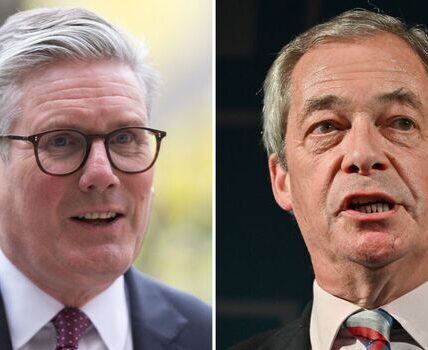
Sir Keir Starmer’s past legal endeavors resurface, casting shadows over his current role. The tangled web of law, politics, and morality unfolds.

Sir Keir Starmer called for European human rights laws to be used to investigate British troops (Image: Getty)
Sir Keir Starmer pushed for European human rights laws to be deployed in probing British troops in Iraq through a chapter he wrote for a book put together by the disgraced lawyer Phil Shiner.
The Prime Minister claimed the Government had made a “deliberate effort” to rewrite international law in his contribution. He maintained it had handed British troops effective immunity whilst they operated in Iraq.
Sir Keir’s piece featured in a 2008 publication called The Iraq War and International Law, assembled by Shiner, who would go on to be convicted of fraud and barred from practising as a solicitor following bogus abuse allegations he made against British soldiers.
The Telegraph has also unearthed a photograph showing Sir Keir and Shiner addressing an audience at a 2014 event celebrating a major European Court of Human Rights (ECHR) judgment.
Former Army chief questions PM’s suitability
Gen Sir Peter Wall, the former Chief of the General Staff who led British forces in Iraq, said on Wednesday it was “shocking” that Sir Keir had associated himself with Shiner, whom he described as “the bane of our lives.”
Sir Peter raised doubts about Sir Keir’s fitness to be Prime Minister, including his authority over the military, given his participation in a legal case that resulted in hundreds of troops facing investigation over bogus war crimes accusations.
Tory leader Kemi Badenoch on Wednesday demanded Sir Keir apologise for his involvement in the case, claiming both the Prime Minister and Lord Hermer, the Attorney General, had assisted people who “act against our country’s national interest.”
Legal documents viewed by The Telegraph and reported on by the Express on Wednesday revealed Sir Keir donated his services to human rights groups on a watershed legal case that determined British law applied in war-ravaged Iraq.
The Prime Minister has been invited to comment via the No 10 website.
Downing Street insists PM assisted on legal points only
Sir Keir’s spokesman maintained on Thursday that the Prime Minister had assisted the court “on points of law, not to advocate for either side.”
But at the hearing conducted before the Law Lords in 2007, Sir Keir, acting for multiple human rights organisations, contended that probes into the deaths of Iraqi civilians had been “perfunctory” and “wholly inadequate.”
Writing in his academic piece that appeared in Shiner’s book, Sir Keir stated that ECHR laws were “far more effective” than United Nations international laws, which he argued had been interpreted and developed by the US and the UK to suit them.
“One cannot read key speeches by US and UK politicians and lawyers without surmising that such a development has involved a deliberate effort by the USA and the UK to change international law for their own ends,” he wrote.
He said that the methods for enforcing ECHR law were “much better developed and far more effective” in holding governments to account, adding: “These things matter.”
PM argued UN forces usually immune from prosecution
Sir Keir maintained that where the UN Security Council had “mandated multinational forces to use force if necessary to achieve certain goals… the force created is usually immune from legal process in the country where it is operating.”
The Prime Minister has faced repeated calls for Britain to withdraw from the ECHR, with critics arguing that continued membership prevents the UK from effectively tackling illegal migration. Sir Keir has rejected those demands, insisting the UK should remain a signatory.
Shiner’s legal challenge, which eventually succeeded at the ECHR in 2012, compelled the Government to widen criminal probes into troops via a new organisation called the Iraq Historic Allegations Team (Ihat).
Sir Keir had ceased involvement in the case by that point, having been appointed Director of Public Prosecutions in 2008.
However back in 2007, Sir Keir acted for multiple human rights organisations without charge after they had joined Shiner’s legal challenge, strengthening allegations filed by the families of six Iraqi civilians killed during British operations.

Keir Starmer with the now-disgraced lawyer Phil Shiner back in 2014 (Image: Middlesex University)

Phil Shiner was convicted of fraud in 2024 (Image: PA)
Investigated soldier says PM must share responsibility
Among the allegations was one that triggered new probes into Sgt Richie Catterall, who told The Telegraph Sir Keir “must share some of the responsibility” for repeated investigations into the fatal shooting of an Iraqi, who was armed with an assault rifle.
Rachel Webster, who was also investigated by Ihat and subsequently received a payout for her wrongful arrest, said: “To now learn that the man who is Prime Minister willingly gave his time for free to drive investigations against veterans like me is deeply distressing.”
Tom Tugendhat, the former Conservative Cabinet minister who served in Iraq and Afghanistan, said Sir Keir’s work had turned British troops into “whipping boys for the courts” and left senior officers “paralysed by potential litigation”.
His comments echoed those of Sir Peter, the former head of the Army, who said: “Phil Shiner… was the bane of our lives.” He said Shiner’s peddling of “spurious” allegations had done “an awful lot of harm” to British troops.
Army chief questions PM’s moral stance
He went on: “The fact that Starmer himself was linked to Shiner, that’s quite shocking, to be honest, that he should end up being the Prime Minister, having linked himself with that guy.”
“If that’s the Prime Minister’s moral stance, then one has to ask questions about how compatible that is with his job of making decisions about putting soldiers in harm’s way in the national interest for defence of the realm.”
A Downing Street spokesman said: “This is a desperate and deliberate misrepresentation.”
However, Matthew Jury, a leading human rights lawyer, said: “When a barrister is instructed by an intervening organisation, they are acting as that organisation’s advocate. While their submissions may be framed to assist the court, describing that role as neutral or independent risks giving a misleading impression of how intervention works in practice.”
A human rights lawyer, who did not wish to be named, said: “It is absolute nonsense to claim he [Sir Keir] was only assisting on points of law. He is not going to be asked to intervene by Amnesty International unless it’s to promote their view on the matter.”